A comprehensive approach to restoring the face and body after significant weight loss
Significant weight loss can be a life-changing accomplishment. Whether achieved through lifestyle changes, bariatric surgery or GLP-1 medications such as semaglutide or tirzepatide, losing weight can improve health, mobility, confidence and overall quality of life.
However, the weight-loss journey does not always end when the number on the scale changes.
Many patients experience facial volume loss, loose neck skin, breast deflation, excess abdominal skin and changes in their overall body contour. These concerns may not improve through diet, exercise, skincare or injectables alone.
At Naples Cosmetic Surgery Center, Dr. Andrew Turk and Dr. William Aukerman recognize post-weight-loss patients as a distinct patient population requiring a different type of evaluation and treatment strategy.
Rather than focusing on one isolated procedure, we evaluate the entire patient through the Naples Restoration Method—a four-tier approach designed to restore natural balance while supporting long-term health, healing and results.
GLP-1 Weight Loss Is Creating a New Category of Plastic Surgery
GLP-1 medications are helping more patients achieve substantial weight loss without bariatric surgery. While this can represent an important improvement in a patient’s health, rapid or significant weight reduction can also affect facial volume, skin elasticity, muscle support and body proportion.
Patients may notice:
- Facial hollowing or a drawn appearance
- Volume loss around the cheeks, temples or under-eyes
- Sagging along the cheeks, jawline or neck
- Loose or crepey neck skin
- Deflated or drooping breasts
- Excess abdominal skin
- Loose skin around the arms or thighs
- Loss of gluteal volume
- Reduced muscle mass
- Changes in overall body shape and proportion
- Continued weight fluctuations or nutritional challenges
These changes are not simply the result of excess skin. Weight loss can affect skin, fat, muscle, connective tissue and the underlying structures that support the face and body.
That is why treatment should begin with a complete evaluation—not a predetermined procedure.
Weight Loss Is Only the First Step
Patients sometimes come to a consultation believing they already know which procedure they need. However, facial hollowing, loose skin, breast deflation and changes in body contour can have several different underlying causes.
The concern may primarily involve:
- Skin quality
- Volume loss
- Tissue descent
- Muscle or fascial support
- Breast position
- Abdominal laxity
- Weight instability
- Overall body proportion
Treating the wrong layer may produce an incomplete or unnatural-looking result.
Rather than beginning by asking, “What procedure do you want?” we begin by asking:
“What has changed, and how can we restore balance naturally?”
This philosophy guides every recommendation made at Naples Cosmetic Surgery Center.
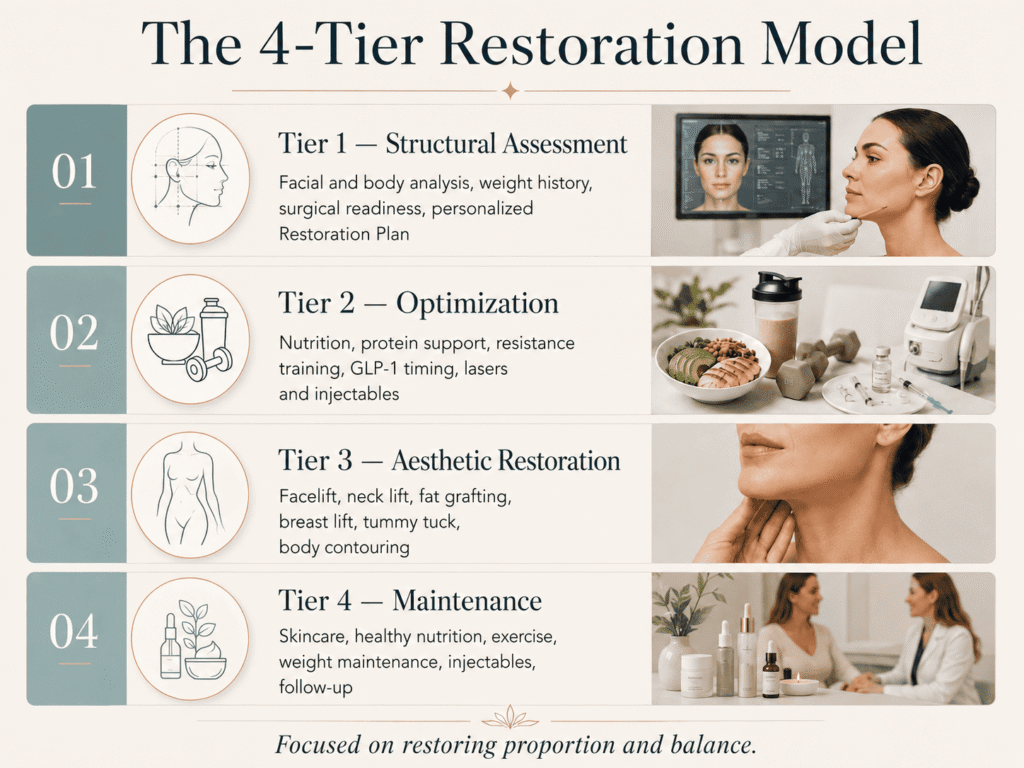
The Naples Restoration Method
A Four-Tier Approach to Post-Weight-Loss Care
Every patient’s anatomy, health and goals are different. However, each post-weight-loss patient is evaluated through the same structured framework:
Assessment → Optimization → Restoration → Maintenance
This process allows us to identify what has changed, prepare the body appropriately, select the right treatment and support the patient’s results over time.
Tier 1: Assessment
Every treatment plan begins with a comprehensive assessment. Dr. Turk or Dr. Aukerman may evaluate:
- Facial architecture
- Facial volume and tissue position
- Skin quality and elasticity
- Muscle and structural support
- Breast volume and position
- Abdominal skin and muscle laxity
- Overall body composition
- Weight-loss history
- GLP-1 or peptide medication history
- Current weight stability
- Nutritional status
- Overall health
- Surgical readiness
- Personal concerns, goals and timeline
This evaluation helps determine whether the patient’s concerns are related to volume loss, loose skin, tissue descent, reduced support or a combination of factors.
The result is a personalized restoration plan based on what has actually changed and which options are most appropriate for the individual.
Diagnosis always comes before treatment.
Tier 2: Optimization
Before considering surgery, we focus on improving the patient’s ability to heal and maintain the result.
Depending on the individual, optimization may include:
- Reaching or maintaining a stable weight
- Protein and nutritional optimization
- Resistance training
- Muscle preservation
- Body composition improvement
- Coordination of GLP-1 medication timing
- Medical clearance and surgical readiness
- Skin-quality treatments
- Laser treatments
- Injectables when appropriate
- Other nonsurgical support
Optimization is not about creating unnecessary delays. It is about making sure the patient’s health, weight and tissues are properly prepared before moving forward.
Nonsurgical treatments may improve skin quality, tone, texture and volume balance. However, they do not replace surgery when the primary concern is significant loose skin, tissue descent or loss of structural support.
Better biology supports better surgical outcomes.
Tier 3: Restoration
Once the assessment is complete and the patient is properly prepared, a personalized restoration plan can be developed.
No two patients age—or lose weight—in exactly the same way. Treatment may involve one procedure, several procedures performed in stages or a combination of surgical and nonsurgical care.
The goal is not to make the patient look like a different person. The goal is to restore natural proportion, support and balance while preserving the patient’s unique identity.
Face and Neck Restoration
Post-weight-loss facial concerns may be addressed with:
- Facelift
- Neck lift
- Eyelid surgery
- Brow lift
- Facial fat grafting
- Dermal fillers
- Botox and other injectables
- Energy-based skin tightening
- Laser resurfacing
Fillers may improve mild or isolated volume loss. However, they may not fully correct loose neck skin, significant facial descent or widespread tissue laxity.
The correct treatment depends on whether the concern involves volume loss, skin quality, tissue position or a combination of these changes.
Breast Restoration
Weight loss can reduce breast volume and stretch the surrounding skin, creating a deflated or drooping appearance.
Potential options may include:
- Breast lift
- Breast augmentation
- Hybrid breast augmentation using an implant and fat
- Breast reduction
- Breast restoration with fat grafting
- A customized combination of breast procedures
The appropriate plan depends on the amount of remaining breast tissue, skin elasticity, breast position and the patient’s desired outcome.
Body Restoration
Post-weight-loss body procedures may include:
- Body contouring after major weight loss
- Tummy tuck
- Arm lift
- Liposuction
- Skin-removal procedures
- Thigh or trunk contouring
- Ultrasound-guided gluteal fat grafting
- A staged combination of body procedures
Not every procedure should necessarily be performed during one operation. When multiple areas are involved, the surgical plan may be divided into stages based on patient safety, recovery and overall goals.
Tier 4: Maintenance
Restoration does not end when surgery is complete. Long-term success may include:
- Maintaining a stable weight
- Healthy nutrition
- Adequate protein intake
- Resistance training and regular exercise
- Muscle preservation
- Medical skincare
- Laser treatments
- Injectables when appropriate
- Ongoing follow-up
- Periodic reassessment as the patient’s needs change
Maintenance helps protect the investment the patient has made in their health and appearance. It also allows surgical and nonsurgical care to work together as part of a longer-term plan.
Restoration is a journey, not a single operation.
Your Options, Chosen Together
Patients are never handed a fixed or one-size-fits-all plan.
During the consultation, surgical and nonsurgical options are reviewed openly. Together, the patient and surgeon determine which combination best fits the patient’s anatomy, health, goals, recovery expectations and timeline.
The right plan may involve:
- One surgical procedure
- Several procedures performed in stages
- Surgery supported by nonsurgical treatment
- A nonsurgical approach alone
- Additional optimization before treatment
- Continued observation until the patient’s weight is stable
Every recommendation is individualized. Patients should understand not only what is being recommended, but also why it is being recommended.
How Naples MedSpa Treatments Fit Into the Method
Medspa treatments can play an important role during optimization, restoration and long-term maintenance.
Depending on the patient, nonsurgical care may help address:
- Skin quality
- Skin firmness
- Collagen production
- Fine lines and wrinkles
- Uneven tone or texture
- Mild facial volume loss
- Scarring or sun damage
- Maintenance following surgery
- Concerns in patients who are not ready for surgery
Available options may include injectables, energy-based skin tightening, laser resurfacing, BBL treatments, PRP therapy and other restorative treatments.
These services are most effective when they are selected as part of a comprehensive plan. They may improve skin quality and refinement, but they cannot fully correct significant loose skin, breast deflation, abdominal laxity or advanced tissue descent.
Who May Be a Candidate for Post-Weight-Loss Restoration?
You may benefit from a restoration assessment if you have experienced:
- Significant or rapid weight loss
- Weight loss after GLP-1 medication
- Weight loss following bariatric surgery
- Facial hollowing or sagging
- Loose skin around the face or neck
- Breast volume loss or drooping
- Excess abdominal skin
- Loose skin around the arms, thighs or trunk
- Loss of gluteal volume
- Changes that have not improved through exercise
- A desire to look healthier, more balanced and more like yourself again

The best candidates are generally at or near a stable weight, in good overall health and prepared to follow an individualized plan.
Patients who are still actively losing weight may begin with an assessment and optimization plan before deciding when surgery should occur.
Why Experience Matters
The newest generation of weight-loss medications is creating anatomical changes that were far less common only a few years ago.
Providing thoughtful post-weight-loss care requires more than offering individual procedures. Plastic surgeons must consider:
- Facial and body anatomy
- Skin quality
- Tissue position
- Muscle preservation
- Nutrition
- Weight stability
- Surgical sequencing
- Healing capacity
- Long-term maintenance
At Naples Cosmetic Surgery Center, post-weight-loss care combines medical assessment with individualized surgical planning.
Every consultation begins with education. Every recommendation is based on the patient’s anatomy, health and long-term goals—not trends.
The Surgeon’s Eye
As part of our commitment to patient education, Naples Cosmetic Surgery Center created The Surgeon’s Eye, a series of conversations in which Dr. Andrew Turk and Dr. William Aukerman explain how experienced plastic surgeons evaluate anatomy, aging, weight loss and restoration.
These discussions are not simply about promoting procedures. They are designed to help patients understand the clinical reasoning behind thoughtful, individualized care.
Because informed patients make better decisions.
Explore The Surgeon’s Eye
Frequently Asked Questions
Begin With a Conversation
If you have lost significant weight and are noticing changes in your face, neck, breasts, abdomen or body contour, the first step is a comprehensive evaluation.
Dr. Andrew Turk or Dr. William Aukerman will assess what has changed, discuss your health and goals, and help you understand which surgical or nonsurgical options may be appropriate.
Assessment → Optimization → Restoration → Maintenance
Because great surgery begins long before the first incision.
Request a Post-Weight-Loss Restoration Consultation Or call 239-316-1689
Naples Cosmetic Surgery Center 6376 Pine Ridge Road, Suite 175
Naples, FL 34119